
Monthly Archives: July 2009

Soup in the Summer: Minestrone


Minestrone with Pesto

Minestrone with Pesto

Well, my promises of summer salads have gone decidedly pear-shaped due to many factors, not the least of which is the fact that the weather has been incredibly unlike summer.  Mom Strati continues to hold out hope that September is going to be our summer month this year, and I can’t help but join her in the optimism.  If anyone in Chicago remembers Halloween last year, I am envisioning that weather all autumn.  It might make the trees a little crazy, but I think that it would be heavenly.  Anyway, since the air these days is more like the upper reaches of Canada than the sweltering heat of Florida, soup seems to be in order.  Minestrone has always been a bit strange to me, because it uses a lot of fresh vegetables that are in season during the warmer months, but it is a hot soup that seems out of place in the midst of the swelter; this summer, however, is perfect for it!  

Since we finally made it to the farmers’ market last weekend, we were able to pick up fresh green and wax beans, zucchini, and yellow summer squash.  Delicious.  I don’t think that there are any real rules to making minestrone, so you should use whatever vegetables you like.  From what I have read, it was invented as a way to use fresh vegetables and any leftovers, pantry items, or canned ingredients you might what to throw into the mix.  All of the ingredients in the following recipe are what I almost always use, bumping up the quanties of some when they are abundant, and pulling back on them when they are not.  I encourage you to cook with your eyes on this one and try to create the most colorful and appealing soup you can.  Start with the soup base and then take over from there with whatever you find at your local market or produce section.  As you see in the picture, we added a little spoonful of homemade pesto just before eating; it may be soup, but it tastes like summer.
Minestrone

Pasta and Pesto


Pasta with Pesto, Summer Vegetables, and Shrimp

Pasta with Pesto, Summer Vegetables, and Shrimp

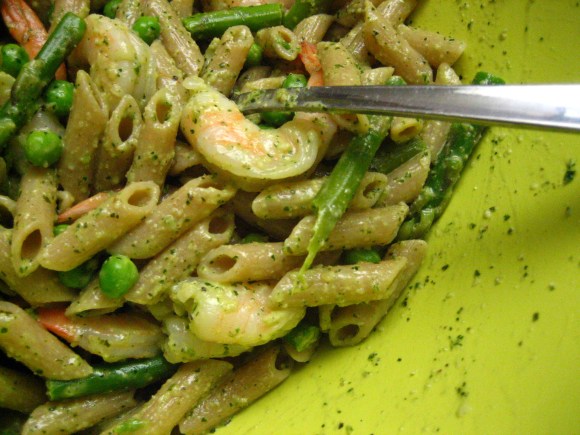
Pasta is usually not on the top of my list of things to eat, but I do really enjoy it on occasion. Since the Bun comes from an Italian-American family, he loves him some pasta of any sort, and I like to keep it lively with different combinations of ingredients. In the summer, I try to let seasonal vegetables lead the way on “one pot” dishes like this, and with green peas and asparagus, the leading color was green. I also wanted to incorporate some light protein (which I always appreciate with pasta), so I thought about adding chicken, but then thought that shrimp would make for a more interesting, more summer-y addition. Going with Heidi Swanson’s advice to cook by color, I decided on my basic pesto as a sauce for this dish. I kept the list of ingredients simple, for the most part, but if you wanted to bump up the variety of vegetables, I think that a little spinach or kale would be a nice color boost and a texture variation. Serve this with a crisp, cold Pinot Grigio and a simple dessert of fruit, nuts and cheese, and I think you have a perfect summer supper – even on a weeknight.

My Basic Pesto

Grilled Indian-Spiced Halibut


Grilled Indian-Spiced Halibut
I can’t really pinpoint when I started enjoying Indian food, but I am sure that it was in college.  Where my mum was adventurous with fruits and veggies, “ethnic” food was not really ever on the menu in my household.  We had Chinese food, but only on rare occasions and only when my dad was not around.  Honestly, I cannot even tell you where there is an Indian restaurant near where I grew up.  Maybe there is one there today.  Regardless, once I was exposed to the saucy, richly-spiced entrees of Indian cuisine, I was hooked.  Part of me just loved the absolutely amazing flavors of these foods, but then part of me started to dig deeper into what I was tasting.  This was well before I knew what tumeric, coriander, fenugreek, and cardamom tasted like on their own, so it was difficult for me to distinguish flavors in the individual dishes.  Only through acquiring these spices, then tasting and smelling them each in turn was I able to figure out just how complex Indian food can be.  

If you are new to creating Indian food, but are eager to learn, I think that there are probably three good pieces of advice I can give you.  First, if you have an Indian friend who likes to cook, I think that is an excellent place to start – ask them if they will show you how to create a basic dish sometime.  You bring the wine and some of the ingredients for dinner.  My dear friend Neena is an amazing chef, and she gets most of the credit for the success of any Indian-inspired dish I make.  She’s the best possible cooking companion – capable, adventurous, and patient.  If you know Neena, I suggest you ask her to cook with you sometime; you’ll be so pleased you did.

Second, I think it is truly important to read up on the ingredients that go into Indian food – you might start with any of the cookbooks by Madhur Jaffrey.  I think that Julie Sahni’s books are supposed to be useful, as well.  Reading through some recipes will allow you to gain an understanding of technique.  You’ll begin to notice that, like stirfry cooking, there is a formula to many dishes that remains constant.  Start with something that looks easy and decide to make it for yourself and someone who loves you – don’t be afraid!  Just have a take out menu handy, in case.  =)  

Third, you should find an Indian market and fearlessly go forth into the aisles upon aisles of exotic ingredients.  The best way to do this is on a full stomach (like any food shopping) and with no preconceived notions of what to expect.  Have a list of things you want to buy (from the recipe you are planning to make that night) and get all of them, plus a few other things that look interesting to you, be they spices or a new kind of bean, or even some kind of fruit or vegetable.  The point of it is that you should gradually build a pantry of ingredients; don’t feel like you have to get everything all at once.  Part of the experience of shopping in ethnic markets is knowing that you’ll be back to buy something new next time (or you’ll find out that the place on the other side of town is cheaper).   

Okay, enough preaching – for those of you who love the flavors of Indian food, but have no idea where to begin, this may be a good place to start.  Though this is not an Indian dish, per se, it captures some of the flavors you might be craving.  If you buy these spices, you’ll be on your way to building a good little spice rack, and you’ll find them in a myriad of Indian recipes.   

Grilled Indian-Spiced Halibut